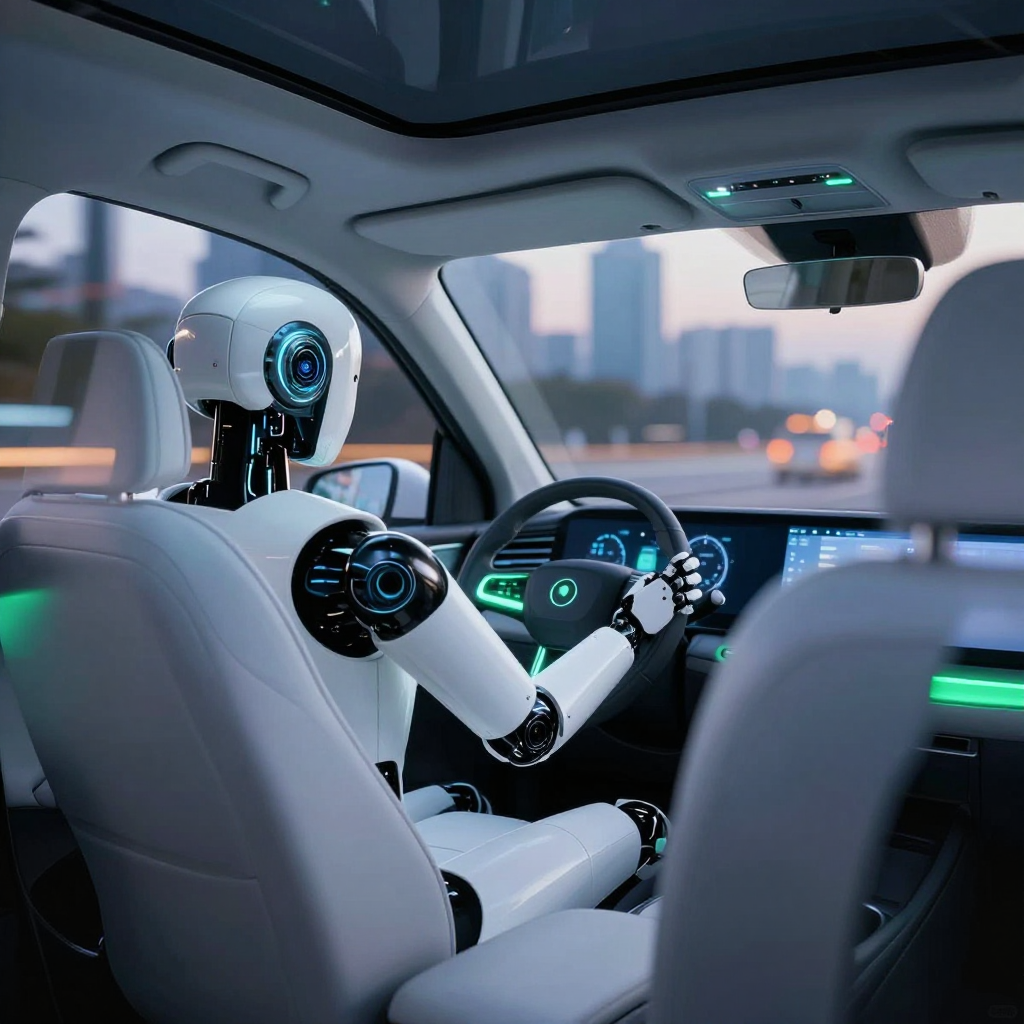
Ask most people when self-driving cars will arrive and they picture the same thing: a robotaxi gliding through a downtown with no one in the driver's seat. That machine is real, and it is already carrying paying passengers in a handful of cities. It is also the single hardest version of the problem the industry has set itself — a vehicle that must handle an open city full of pedestrians, cyclists, and human drivers, in the most visible and most litigated setting there is.
Meanwhile, the first driverless vehicles to work at genuine commercial scale have been quietly doing so somewhere else. Autonomous haul trucks have moved ore around mine sites for years. A driverless-capable freight lane now runs between Dallas and Houston. Container movers operate inside ports where the public never sets foot. None of these make the evening news, and all of them are further along, as businesses, than the robotaxi we all picture.
That gap between the visible story and the working one is the clue. It tells us that "will autonomous driving work?" is not a single question with a single date. It is a set of separate questions, each answered a layer above the technology — by whether a place will permit the vehicle, whether anyone can insure it, and whether people will ride in it. The engineering is necessary but no longer the binding constraint. This piece maps the constraints that are.
Autonomous driving is not one thing
Start from first principles. A "self-driving vehicle" is not a product; it is a mission carried out under conditions. Change the mission or the conditions and you have a different business with a different timeline. Five dimensions do most of the sorting.
- Mission — move people (robotaxi), haul freight down a highway, deliver goods the last mile, or move material inside a private site (mining, ports, yards, farms).
- Operational design domain (ODD) — the conditions the system must master: private land versus highway versus dense city; low speed versus high; fair weather versus all; a fixed geofenced route versus go-anywhere.
- Liability and insurability — when there is no driver, who owns the accident, and can that risk be priced and transferred?
- Economic justification — why automate this mission at all: a labour shortage (long-haul trucking has a chronic one), safety (human error is a factor in roughly 94% of crashes, on the long-standing US regulatory estimate), round-the-clock utilisation, or removing people from dangerous, repetitive work.
- Ownership model — a fleet selling rides or hauls, versus a privately owned car; a captive operation versus a platform.
Lay the real deployments against these and a clear order of arrival appears — and it is close to the inverse of the attention each one gets.
| Deployment | ODD difficulty | Liability clarity | Economic pull | Public exposure | Where it stands |
|---|---|---|---|---|---|
| Industrial / off-road (mining, ports, yards) | Low — private land, fixed routes, low speed | High — private site, no public third parties | High — labour + safety + uptime | Low | In commercial service, years already |
| Highway freight (long-haul trucking) | Moderate — structured, but high speed | Improving — commercial fleet, clearer duty | Very high — driver shortage + freight cost | Moderate | First driverless lanes live in 2026 |
| Last-mile delivery (pods, small vans) | Moderate — low speed, no passengers | Moderate | Moderate — labour + density | Moderate | Scaling in permissive cities |
| Urban robotaxi (passengers) | High — open city, all actors | Contested — passengers, public, courts | High — but capital-heavy | Very high | Live in a few cities; the hardest cell |
The point is not that the robotaxi will fail — it is advancing quickly, and in the right city it already works. The point is that it sits in the corner of the matrix where every dimension is set to its hardest value, which is why it arrives late even though it arrives loud. The missions that clear the bar first are the constrained ones: a fixed route on private land, or a structured highway with no passengers and a large labour saving to pay for the effort. Autonomous driving is, in effect, entering through the industrial and freight doors while the world watches the passenger door.
The empty seat: why the binding constraint is often the insurance
Of the five dimensions, one does more gating than the rest, and it is the one the coverage tends to skip. It hides in the empty seat.
A human driver does two jobs at once. They are the cause of the overwhelming majority of accidents, and they are the bearer of the resulting liability — a responsibility priced, pooled, and transferred through a deep, liquid market for personal motor insurance. Human-driven taxis are still the mainstream, not history; but take the driver out of the seat and the second job does not disappear with the first. The liability remains. It simply has nowhere to sit until the law decides where to put it.
That single reassignment is what actually gates deployment.
Follow the loop the reassignment creates, because it explains the timelines better than any autonomy benchmark:
1. Regulation must define who is liable. Until the law names the responsible party — maker, operator, or insurer — no one knows what they are underwriting. 2. That definition sets insurability. Only once liability is defined can the tail risk of a driverless fleet be priced and transferred. Undefined risk is uninsurable risk. 3. Insurability gates deployment. No serious operator puts a fleet on public roads carrying an uninsurable tail. The cover has to exist first. 4. Deployment generates the data — miles, incidents, interventions — that lets insurers price the risk properly, which in turn informs the next round of regulation.
Every step waits on the one before it. It is the same reason the constrained missions run ahead: an autonomous truck on private mine roads, or a container mover inside a port, sidesteps most of this loop because there are no public third parties to injure and the site owner already carries the risk. The freight lane is a harder case than the mine but an easier one than the city, and the insurance market is forming around it accordingly.
There is a deeper reason the new cover is hard to write, and it is worth naming because it shapes the whole timeline. Human driving fails independently — one driver's lapse tells you nothing about the next, which is exactly what lets an insurer pool millions of motorists into a stable, diversified book. An autonomous fleet fails together. The same software build runs every vehicle, so a single unhandled edge case, a flawed update, or a cyber intrusion can, in principle, touch the whole fleet at once. That correlation turns a broad, diversifiable retail risk into a concentrated, systemic one — closer to how a reinsurer prices a hurricane than how a motor insurer prices fender-benders. The risk is insurable, but it must be underwritten differently, and that is part of why the market forms cautiously even where the law is ready.
And to price any of it, an insurer needs data — the lifeblood of the business. The richest base of miles, incidents, and interventions sits in only a handful of places: the few cities and corridors where driverless fleets already run at scale. That does not lock a new market out, and it helps to say why, because insurance has met this problem before. Mortality varies by region, yet no life insurer waits for a full local death experience before writing cover; it starts from a comparable reference table, loads a margin for the uncertainty, and refines the price through experience studies as its own claims come in. Autonomous-fleet cover will bootstrap the same way — priced off a genuinely comparable market at first, conservatively, then tuned as local miles accumulate. The catch is that the data travels imperfectly: a record from wide, dry, orderly roads only partly describes a dense, wet, informally-driven city, so the early loadings are heavier and the keenest prices still belong to whoever holds the local experience. The effect, then, is a gradient rather than a wall — insurability and the sharpest pricing concentrate where the miles already are, slowing and skewing the map without ever fully sealing a market shut, and making accumulated operating data one of the more valuable assets in the business.
That gradient has a geography of its own. Proximity to the data — commercial, and increasingly jurisdictional — counts as much as proximity to the roads, because the operating record sits with the fleets and regulators of the two ecosystems running at scale: the United States and China. Insurers close to those pools can access, license, or co-develop against them; those further away start a step behind. And because data-export controls cut both ways, the two pools may never fully merge, which would leave American and Chinese insurers each strongest in their own sphere and everyone else pricing at second hand. A market that sits near one pool while trading openly with the other — as several financial centres in Asia do — holds a seam worth occupying rather than a gap to fall into.
For anyone building or backing in this space, that reframes the first question to ask. It is often not "how good is the autonomy?" but "is the liability defined here, and is the cover priceable?" A market where the answer is no is not open, however good the technology — and a market where someone is quietly solving the insurance is opening, whatever its fleet looks like. We return to what that means for each player below. First, the map it produces.
The map today
With that gate in view, the map of who operates where reads less as a ranking of technology and more as a ranking of who has resolved permission and risk first. In mid-2026 the picture is of a capability that has outrun the rules in some places and is waiting on them in others.
| Market | Status | What it reveals |
|---|---|---|
| United States | 18 states allow fully driverless commercial operation; a purpose-built, wheel-free robotaxi cleared federal approval to charge for rides; one operator exceeds a million paid trips a week | Capability is proven at scale; a state-by-state patchwork and an active liability environment pace the rollout |
| China | Driverless commercial robotaxi permitted in 40-plus cities; paid, no-safety-driver services running in several | A coordinated regulator plus lower-cost, purpose-built vehicles compresses the path from pilot to paid |
| UAE | Fully driverless rides live in Abu Dhabi with a global ride-hailing partner supplying demand; wider Gulf rollout underway | A permissive regulator can import vehicles, technology, and demand and stand up a market quickly |
| United Kingdom | Commercial services planned; the Automated Vehicles Act is passed but not yet in force, with the implementing rules still pending | A market can be ready on the technology and still wait for its own law to switch on |
| Singapore | Structured testing on defined districts and routes, with a ride-hailing partner | A measured, corridor-by-corridor path that prizes public confidence |
Read across the right-hand column and the same lesson repeats: the leading markets are not the ones with the best autonomy, they are the ones that have resolved permission and risk fastest. China moved early because a coordinated regulator, dense cities, and lower-cost domestic vehicles line up together. The Gulf moved quickly because a willing regulator can import all three ingredients — vehicles, technology, and demand — at once. The UK is the subtler case: its Automated Vehicles Act is already on the books, but the secondary rules that bring it into force are still pending, so the country is ready on the vehicles and waiting on its own law to take effect.
One layer sits above all of these national efforts, and it is worth knowing because it is the closest thing to a shared rulebook for the automated vehicle. WP.29 — the UN's World Forum for Harmonization of Vehicle Regulations, in Geneva — exists to keep vehicle-safety rules compatible across borders: through its long-standing mutual-recognition agreement, a vehicle approved to a common standard in one member country can be accepted across the others, sparing makers dozens of separate certifications. Its most consequential output so far is UN Regulation No. 157, the first binding international rule for a hands-off Level 3 system — the reference point national regulators now model their own Level 3 rules on — and it is working toward a common safety framework for fully driverless systems. That is why it matters to our map: harmonization at this level is what could eventually let an operator prove a vehicle safe once and deploy it across many markets, rather than restarting the permission-and-risk climb in each.
What works, what doesn't, and why
Put the three sorters together — mission, permission, and the risk loop — and the pattern that looked like noise becomes a rule.
It works first where the domain is constrained, the risk is contained, and the labour saving is large. Industrial and off-road sites clear all three by construction. Highway freight clears most of them, and the economic pull is enormous, which is why serious driverless-capable operations are launching there in 2026. These are the quiet arrivals, and they are the real leading edge.
It works next where a regulator resolves permission and risk together, and vehicles are affordable enough to make the economics close. That describes China's larger cities and, by deliberate design, the Gulf. The recipe travels — but only in full. Importing the vehicles without resolving the liability leg, or resolving the law without the demand density to fill the fleet, leaves a market stalled at pilot. This is precisely why the same recipe that works in one city does not simply drop into another: the ingredients are complementary, and a market moves only when it has all of them.
It works last where the domain is hardest and society's tolerance is thinnest — the open, litigious, lower-trust city. Public sentiment there is genuinely divided; surveys through 2026 show roughly as many people saying autonomous vehicles feel less safe as say they feel more safe, and trust skews sharply by age. In that setting a single viral incident can reset a rollout by a year, which is why the measured, corridor-by-corridor approach — Singapore's, and increasingly the cautious US and UK posture — is a rational response, not merely a timid one.
None of this says the city robotaxi will not happen. It says the honest sequence runs from the mine and the motorway toward the city centre, and that the pace is set by law and trust, with the technology and the economics following behind. Which is why a single "self-driving moment" — imminent everywhere, or forever five years away — is the wrong thing to wait for. There is no one moment. There is a matrix, filling in one cell at a time.
What this means for everyone with a stake in the ride
For those building or operating fleets: choose the cell before the technology. A constrained mission in a permissive jurisdiction with a resolved liability regime will reach paid operation years before an ambitious one in a contested market, whatever the demo footage shows. The scarce inputs are permission and insurability; treat them as gating, not as paperwork to sort out later.
For investors: underwrite the enabling stack, not the autonomy score. Ask whether the market's liability is defined and its cover priceable before asking whose model drives best; a superb autonomy stack in a market with no insurance leg is a science project with a burn rate. Treat accumulated operating data as an asset in its own right — a new market can bootstrap its pricing off a comparable one, but the operator that holds the local record prices the risk keenest, an edge a newcomer has to pay up to match. And look hard at the freight and industrial cells, where the economics are clearer and the regulatory path shorter than the robotaxi headlines imply.
For insurers: the empty seat is an opening — and a genuinely new underwriting problem, not merely a bigger one. The retail motor policy shrinks over a long horizon while a new commercial line grows in its place: fleet-scale, product-liability-flavoured, priced on operational data, and shadowed by the correlated-risk problem above. It is early enough that the pricing models and the data partnerships are still up for grabs, and the firms that learn to price the systemic tail — not just the average mile — will help decide which markets open at all.
Those three are the players deciding what to build, back, and underwrite. But a driverless fleet does not arrive on an empty stage — it lands on an existing taxi ecosystem of people and businesses, and an honest map has to account for them too.
For the people who drive for a living — the part of this that deserves the most care: the change lands hardest here, and it lands on livelihoods, not spreadsheets. Driving for hire is one of the largest occupations in the world and, for many, the most accessible route to independent work — often the first rung for someone new to a city or a country. Aviation offers a fair guide to the shape of what is coming: it did not stop needing pilots when remotely operated aircraft arrived — the skill moved, from the cockpit to a ground station where one specialist, trained differently, oversees several aircraft from a screen. Driving follows the same pattern. The role does not vanish so much as relocate and thin — into remote-assistance centres, fleet operations, depots, and maintenance — and "one operator oversees several" is precisely the point: the new roles are fewer, and ask for different skills, so "new jobs will appear" is a true but insufficient answer. The transition is also uneven, filling in slowly and displacing different workers in freight and on industrial sites than in the city taxi. The honest position is that this is a real labour transition owed a deliberate response: retraining, timelines that give people room to adapt, and a share of the productivity gain routed back toward the workforce it displaces. We would rather name that plainly than pretend the gains are costless.
For fleet owners, licence and medallion holders, and the garages that keep cars on the road: the value of the asset changes shape. A taxi licence drew its worth from scarcity and from the driver it authorised; as supply shifts toward fleets that need no licensed driver, that scarcity value is exposed. Incumbents with real operating assets — depots, dispatch, local regulatory relationships — are well placed to pivot into fleet operation or service partnerships; those whose only asset was the licence itself have the least cover. The garage faces the same fork: routine mechanical work thins, while sensor calibration, compute upkeep, and fleet servicing grow for those who retool.
For cities and regulators: the permission-and-risk decisions this piece has described land on them — alongside harder questions the technology sharpens: licence and congestion revenue that may erode, curb and traffic management, equitable access across neighbourhoods and for riders with disabilities, and the public-trust cost of setting the pace wrong in either direction. The measured, corridor-by-corridor posture is, in part, simply the sight of a regulator holding all of these at once.
For riders and the public: the potential gains are real — lower fares once the economics close, mobility for people poorly served by today's system (the elderly, riders with disabilities, thin late-night markets), and, if the safety case holds, fewer crashes on roads where human error is the leading cause. Those gains are also the social licence the whole enterprise depends on — the reason the disruption is worth managing well rather than either rushing or resisting.
Coda: read the map before the meter
Whether a driverless fleet makes money is a question worth answering carefully — and it is the one we turn to next in this series. But it is the second question, not the first. A fleet only gets to have unit economics once it is allowed to operate, insured to operate, and accepted by the people it serves. Those three conditions, not the quality of the autonomy, decide where the wheels turn first.
So the trend is real, and it is arriving — just not as a single event, and not first where the cameras are pointed. It is arriving in mine pits and shipping ports and on a Texas freight lane, one constrained, well-insured, economically justified cell at a time, and working inward toward the city. Read the map that way and the future stops looking like a light switch and starts looking like what it is: a sequence, already under way, whose order you can predict if you know which conditions have to be met first.
Next in this series — Part 2: when the meter turns green. Once a fleet is allowed and accepted, does the math actually close? We build the per-mile economics from the ground up.